Most small business owners think about reviews in terms of how many they have. They celebrate hitting 50. They aim for 100. They point to their star rating as proof of quality. What they rarely consider is when those reviews arrived — and that oversight is quietly costing them local search rankings every single month.
Review freshness — how recently and how steadily new reviews arrive — has climbed sharply in the local ranking factor research from Whitespark and BrightLocal. In Whitespark's 2026 survey, the recency of reviews ranked as the 11th most influential factor for the local pack and Maps. A business receiving four or more new reviews per week now often outranks one with a much larger total sitting dormant. Understanding why this happened and what to do about it is one of the highest-value actions any local business can take right now.
What Review Velocity Actually Means
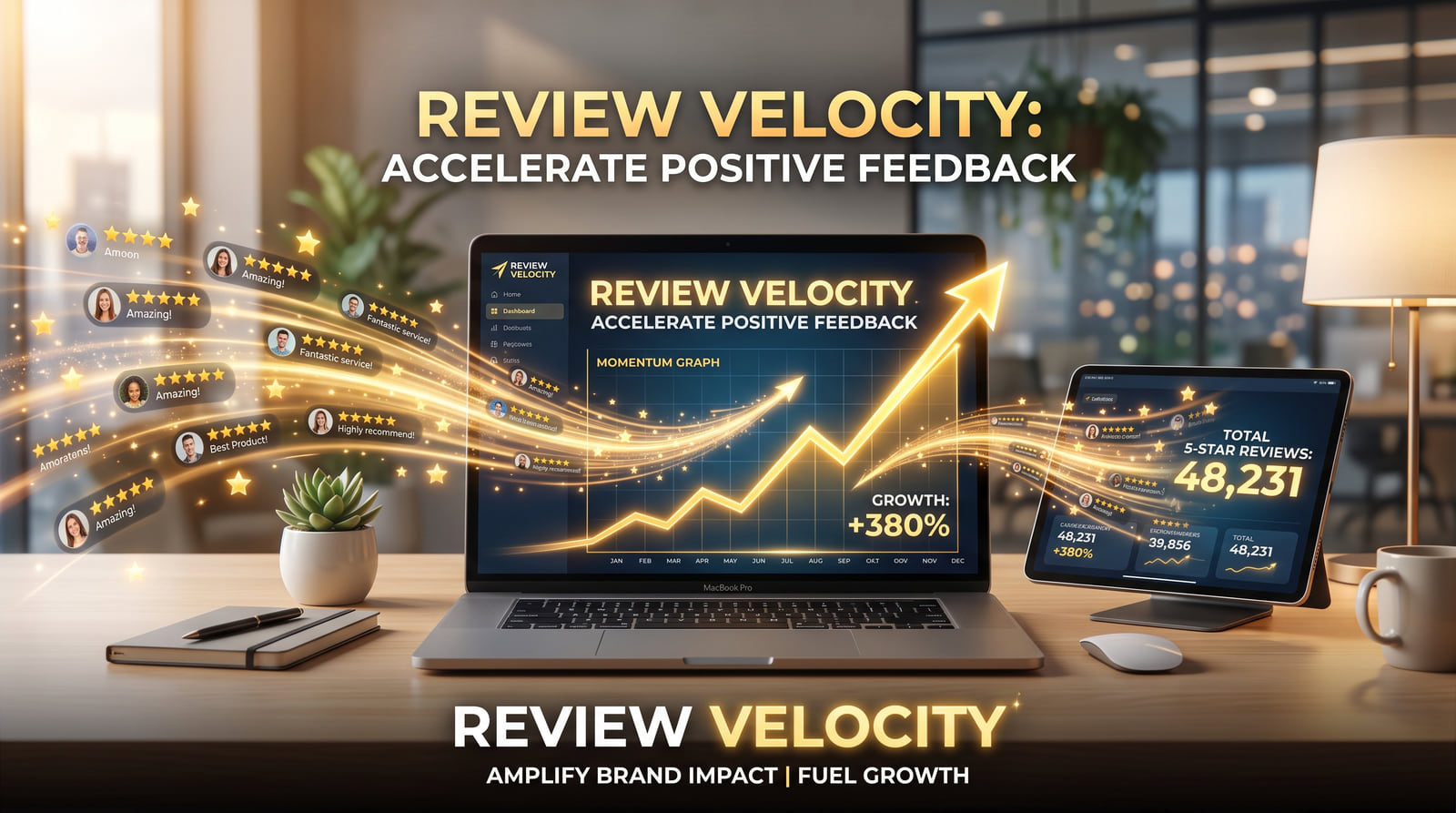
Review velocity measures how frequently new reviews arrive at a business profile over a defined time window. The algorithm weights the last 90 days most heavily. A consistent stream of fresh reviews — even a modest one — carries more ranking power than a large historical total that stopped growing.
The practical implication is significant. Two businesses in the same category, same city, same star rating, but different review patterns will rank differently. The one receiving reviews steadily will outrank the one that ran a review campaign two years ago and has not collected a single new one since. The gap between them widens every month the dormant business stays inactive.
Business A: losing ground
400 total reviews. Last new review: 18 months ago. Strong historically, but increasingly invisible in 2026 local results.
Business B: gaining rankings
80 total reviews, with 12 new ones in the last 90 days. Consistently outranking Business A despite fewer total reviews.
This pattern appears repeatedly in local SEO audits throughout 2026. According to analysis published by Sprout Sage Solutions in June 2026, a business with 80 reviews and 12 new ones in the last quarter routinely outranks a competitor with 400 reviews and zero new in a year when all other signals are equal. The shift is real, measurable, and accelerating.
Why the Algorithm Changed: The AI Connection
The rise of review velocity as a ranking signal is not arbitrary. Behind the shift is a structural change in how local search works in 2026. Google AI Overviews, Perplexity and ChatGPT increasingly answer local queries by synthesizing current information about businesses. To do that accurately, they need recent review content.
In other words, review velocity now serves two simultaneous purposes. First, it directly influences traditional local pack rankings. Second, it determines whether a business has sufficient recent review content for AI systems to cite with confidence. Businesses that collect reviews consistently are therefore building two compounding assets at once — and those that do not are losing ground on both fronts simultaneously.
The Five Review Signals Google Evaluates
Review signals collectively account for approximately 20% of local pack ranking weight in 2026, according to Whitespark's survey of 47 expert local SEOs — the most widely cited annual research in the field. Within that 20%, Google evaluates five distinct sub-signals rather than a single overall review score.
| Review Signal | What Google Measures | Weight in 2026 |
|---|---|---|
| Velocity | New reviews per week weighted to last 90 days | Very High ↑ |
| Recency | How recent the newest reviews are | High |
| Quantity | Total number of reviews on profile | High |
| Sentiment | Language quality and specificity of review content | Medium |
| Response Rate | Percentage of reviews with an owner response | Medium ↑ |
Velocity and recency together now outweigh quantity alone. Response rate — the percentage of reviews that receive a reply from the business owner — has risen measurably in the 2026 surveys. Businesses responding to 80% or more of their reviews see a measurable ranking benefit compared to those who never reply.
What Review Velocity Looks Like in Practice
Translating this into practical terms means understanding what a competitive review velocity target looks like for your business type and market size. Not every business needs the same rate of review collection to stay competitive.
Velocity Targets by Business Type
In a small local market, two to four new reviews per month may be sufficient to maintain competitive velocity. In a larger city with multiple competitors actively collecting reviews, four to eight per month becomes the minimum threshold to stay visible. High-volume service businesses — restaurants, salons, clinics — should target two or more new reviews per week to maintain the freshness signal that keeps them prominent in both the local pack and AI-generated summaries.
Pattern consistency matters as much as volume. A steady stream of two reviews per week signals sustained activity to the algorithm. Thirty reviews collected during a single campaign followed by three months of silence registers differently and less favorably than the same thirty reviews arriving gradually over that same period.
Building a Review Velocity System That Runs Without You
The businesses with the strongest review velocity in 2026 are not spending more time on reviews than their competitors. They have built simple, repeatable systems that generate review requests automatically as part of their normal customer interaction process. Reviews arrive consistently without requiring manual effort after initial setup.
Create a direct review link
Go to your Google Business Profile, click "Ask for reviews" (sometimes labeled "Get more reviews"), and copy the direct link. This sends customers straight to the review form with zero navigation required. Fewer steps means more completions.
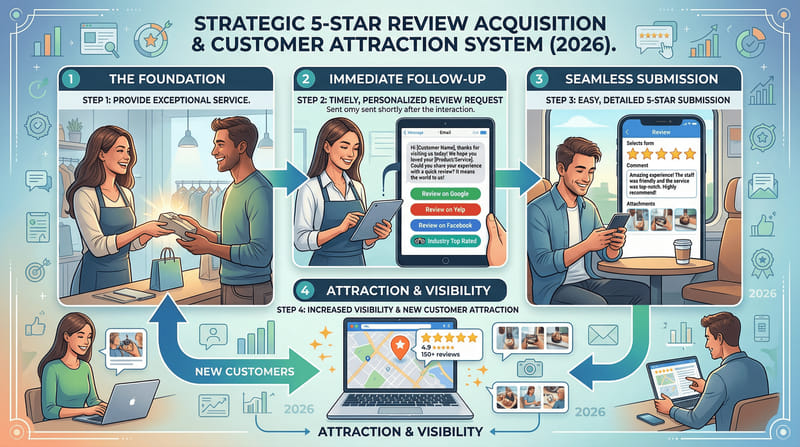
Ask within 24 hours of every completed job
Satisfaction peaks immediately after a positive experience and drops sharply within 48 hours. Send your review request the same day — not a week later. As shown in how to earn five-star reviews that drive more bookings, timing is the single most controllable factor in review conversion rate.
Use a two-sentence request — nothing longer
A short, warm message outperforms a long, formal one every time. Something like: "Really glad everything went well today. If you have two minutes, a quick Google review would mean a lot — here is the direct link." Brevity respects the customer's time and removes the friction that causes most review requests to go unanswered.
Responding and Tracking Consistently
Respond to every review within 24 hours
Response rate is now a measurable ranking signal. Responding publicly to reviews — including negative ones — signals professionalism to every future customer who reads your profile. As explained in how to handle negative reviews without damaging your reputation, a thoughtful response to a difficult review often builds more trust than a string of five-star ratings with no responses.
Track your velocity monthly
Check how many new reviews you received in the last 30 days. Compare to the previous month. Set a minimum target — even two per month for a very small business — and treat missing it as a signal to adjust your request process rather than a reason to abandon it.
Directory Reviews Contribute Too
The Businesses Most at Risk From Ignoring Review Velocity
Established businesses with strong historical review counts are paradoxically among the most vulnerable to this shift. Many built a solid review profile between 2019 and 2022 and have coasted on that reputation since. In 2026, that approach no longer works. A competitor with fewer total reviews but a consistent monthly collection habit is now outranking them — and the gap widens every month without intervention.
Service businesses where customers interact infrequently — legal services, healthcare, specialist contractors — face an additional challenge. Each client interaction is precious and cannot be wasted. For these businesses, the ask needs to be perfectly timed and the request needs to feel personal rather than automated. The system still applies but the execution requires more care at each individual touchpoint.
The broader point is this: review velocity is no longer a growth tactic for ambitious businesses. It is a maintenance requirement for any business that wants to hold its current local ranking position. The algorithm has changed. Businesses that adapt this year will compound that advantage throughout the rest of the decade. Those operating on a 2022 review playbook will find themselves steadily less visible without ever understanding why. Start by building your presence across reputable listing platforms and implementing the complete listing checklist, then layer a consistent review collection habit on top. Those two things together represent the most impactful local SEO investment any independent business can make right now.
List your business for free
Create a verified listing on Listings Junkie and give the customers in your area one more place to find your business name, address, phone and website.