
What Is Local SEO?
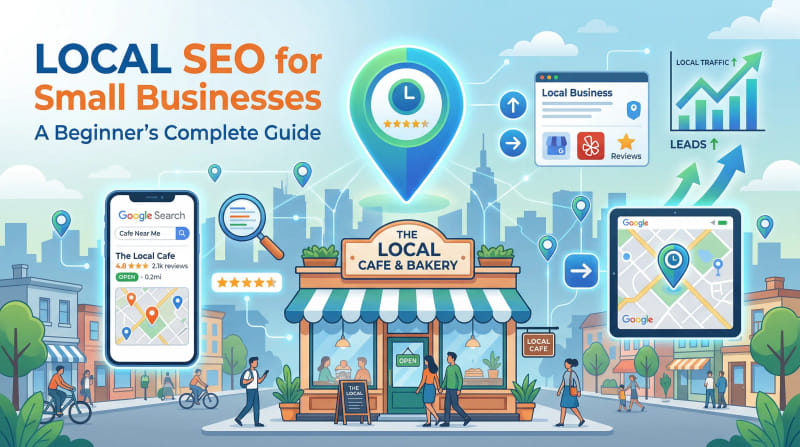
Local SEO — short for local search engine optimization — is the process of improving your online visibility so that nearby customers can find your business when they search for products or services in your area. Unlike traditional SEO, which targets a global or national audience, local SEO for small business owners focuses on geographic relevance, proximity signals, and community trust.
In practical terms, local SEO determines whether your cafe appears when someone types "best coffee near me," or whether your plumbing company shows up when a homeowner urgently searches for "emergency plumber in your city." Therefore, mastering local SEO is not optional — it is the single most cost-effective digital strategy available to small, location-based businesses.
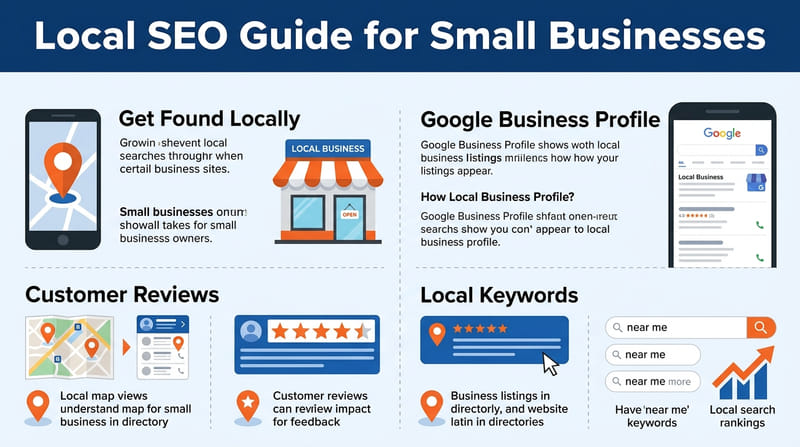
Local SEO encompasses three core pillars — your Google Business Profile, consistent Name-Address-Phone (NAP) data across the web, and locally relevant on-page content. As a result, when all three work in harmony, your business climbs into what Google calls the Local Pack — the coveted map-based results shown above organic listings. As explained in why NAP consistency matters for local rankings, the three pillars are inseparable and must be maintained consistently together.
Why Local SEO Matters for Small Businesses
Many small business owners assume that local SEO is only relevant for large enterprises with dedicated marketing teams. However, the opposite is true. In fact, small and medium-sized businesses benefit more from local SEO because geographic targeting narrows the competition dramatically.
Consider a local bakery competing nationally for the keyword "artisan bread." That battle is unwinnable. The same bakery optimized for "artisan sourdough bakery in your neighborhood" can reach page one within weeks. Those searchers are not browsing idly — they are within walking distance and ready to buy immediately.
Local SEO levels the playing field financially. Paid advertising can drain budgets quickly, whereas organic local rankings generate free, compounding traffic month after month. Every hour invested in optimizing your local presence pays dividends long after the work is done. As demonstrated in how listing your business drives real growth, this compounding effect is one of the most reliable growth mechanisms available to any small business owner today.
Optimize Your Google Business Profile
Your Google Business Profile (GBP) is the single most important asset in any local SEO strategy. First and foremost, claiming and fully completing your profile is non-negotiable. Businesses with complete profiles receive significantly more clicks, calls, and direction requests than those with sparse or unverified listings.
Essential GBP Optimization Steps
- Claim and Verify Your Listing: Go to business.google.com, search for your business, and follow Google's verification process — typically by video, phone, email or postcard.
- Complete Every Field: Include your exact business name, address, phone number, website URL, business hours, and a thorough description containing your primary keywords naturally.
- Select the Right Categories: Choose your primary category carefully — it carries the most ranking weight. Add relevant secondary categories to widen your reach.
- Upload High-Quality Photos: Businesses with photos receive 42% more direction requests. Therefore, add images of your storefront, interior, team, and products — and update them regularly.
- Use Google Posts Weekly: Google Posts function like mini social-media updates within your profile. Use them to announce offers, events, or news, keeping your listing fresh and engaged.
- Keep Your Hours Current: Update your hours for holidays and special events so "open now" searches always show you correctly.
On-Page Local SEO Tactics
Beyond your Google Business Profile, your website itself must send strong local signals to search engines. On-page local SEO involves optimizing individual pages so that Google clearly understands where you operate and whom you serve. Even a modest website can rank highly when on-page elements are properly configured.
Key On-Page Elements to Optimize
- Title Tags: Include your primary keyword and city — for example, "Plumber in Austin TX | Your Business Name."
- Meta Descriptions: Write compelling, city-specific descriptions that encourage clicks. Include your service and location naturally.
- H1 Heading: Your page's main heading should contain the service and location you are targeting.
- NAP in the Footer: Display your Name, Address, and Phone number consistently on every page — ideally in the footer of every single page.
- LocalBusiness Schema Markup: Add structured data so Google can read your business details with machine-level precision and accuracy.
- Dedicated Location Pages: If you serve multiple areas, create individual pages for each location rather than lumping them together.
- Locally Relevant Content: Write blog posts about local events, news, or topics that connect your business to the community.
Internal linking plays an underrated role. When your blog posts link back to your main service pages using location-specific anchor text, Google better understands the topical and geographic relevance of those pages. As a result, even secondary pages contribute meaningfully to your overall local authority and ranking position.
Local Citations and Business Directories
A citation is any online mention of your business's Name, Address, and Phone number — even without a link. Citations are a core ranking factor in local search, and therefore, building them consistently across authoritative directories strengthens your credibility in Google's eyes significantly.
Start with the most important directories first. In addition to Google, your business should appear on Listings Junkie, Yelp, Bing Places, Apple Business Connect, Facebook and Foursquare. Local Chamber of Commerce listings and regional business associations carry particularly strong geographic signals that help Google understand your service area clearly. For a comprehensive list, work through the 10 best business listing sites in 2026.
Beyond directories, unstructured citations — mentions of your business name in blog posts, news articles, or social media posts — also contribute to your local authority. Therefore, seeking press coverage in local publications and getting featured in community round-up posts provides both citation value and potential referral traffic to your website.
Reviews and Online Reputation Management
Reviews are arguably the most powerful trust signal in local SEO. Google's algorithm weighs the quantity, quality, recency, and diversity of your reviews when determining local rankings. From a customer's perspective, 93% of consumers say online reviews influence their purchasing decisions — making reputation management both an SEO and a conversion priority simultaneously.
How to Generate More Reviews Consistently
- Ask satisfied customers directly — in person, via email, or by text — at the peak moment of satisfaction after a positive experience
- Create a short, shareable review link from your Google Business Profile and include it in receipts, email signatures, and follow-up messages
- Add a "Leave Us a Review" button to your website and thank-you pages
- Respond to every review — positive or negative — professionally and promptly without exception
When handling negative reviews, resist the urge to be defensive. Instead, acknowledge the concern, apologize where appropriate, and offer to resolve the issue offline. As a result, prospective customers see a business that cares — which often converts more effectively than a perfect five-star average without any responses at all. As covered in how to respond to negative reviews professionally, thoughtful responses consistently build more trust than silence. As shown in how to get 5-star reviews that bring more customers, building a systematic review collection habit produces compounding improvements every month.
Local Link Building Strategies
Backlinks — links from other websites pointing to yours — remain one of Google's most important ranking signals. However, for local SEO, the locality and relevance of those links matter as much as their raw authority. A link from your city's news website is often worth more than a link from a generic national blog with high domain authority.
Effective Local Link-Building Tactics
- Sponsor Local Events: Community sponsorships frequently result in a link from the event's website — a natural, high-quality local backlink that carries strong geographic signals
- Partner with Complementary Businesses: Cross-promotion with neighboring businesses can generate mutual links and consistent referral traffic
- Pitch Local Press: Offer expert commentary to local journalists or bloggers covering your industry. Share genuinely newsworthy stories about your business milestones
- Join Local Associations: Membership in your Chamber of Commerce or trade association typically includes a directory listing with a backlink to your website
- Create Locally Useful Resources: A "Best-Of" guide for your city or a helpful local resource page attracts natural links from community sites and bloggers organically
Mobile and Voice Search Optimization
More than 60% of local searches now happen on mobile devices, and voice search continues its rapid ascent. Therefore, any effective local SEO strategy must address how people search on smartphones and smart speakers specifically. Voice queries tend to be longer and more conversational than typed searches. Instead of "dentist Austin," a voice user might ask "What's the best dentist near me that's open on Saturdays?" As a result, your content should answer natural-language questions — particularly the classic who, what, where, when, and how queries relevant to your service area.
Mobile Optimization Checklist
- Ensure your website loads in under 3 seconds on mobile — use Google PageSpeed Insights to identify specific issues
- Use responsive design so your site adapts seamlessly to any screen size
- Make your phone number a clickable "tel:" link so mobile users can call with one tap
- Add an FAQ section to your website addressing common local questions about your business
- Embed a Google Map on your Contact page to reinforce your location signal for both users and search engines
Tracking Your Local SEO Progress
Effective local SEO is not a one-time effort. Rather, it is an ongoing process of monitoring, testing, and refining. Without tracking, you cannot know what is working, what needs adjustment, or how your rankings compare to competitors. Fortunately, several free and affordable tools make measurement straightforward for any business owner.
- Google Business Profile Insights: Tracks how customers find your profile, what actions they take, and how your photos perform monthly.
- Google Search Console: Shows which search queries drive traffic to your website along with click-through rates and impressions.
- Google Analytics 4: Reveals which pages attract local visitors, how long they stay, and which channels send the most traffic.
- BrightLocal or Whitespark: Affordable paid tools for tracking local keyword rankings and monitoring citation health across directories.
Set a monthly review cadence. Examine your GBP insights, check for new or unresponded reviews, audit your citation consistency, and review any fluctuations in your local keyword rankings. Benchmark your performance against two or three direct local competitors to identify gaps and opportunities. As a result, your local SEO strategy will evolve intelligently rather than remaining static month after month.
Start Building Your Local SEO Foundation Today
You now have a complete local SEO playbook for small business success. The next step is simple — start with your Google Business Profile today, then build your citation network, collect reviews systematically, and optimize your website for local search terms. Create your free listing on Listings Junkie as your first citation outside of Google. Even 30 minutes of focused optimization this week can meaningfully shift where your business appears in local search results.
Follow the complete business listing checklist to make sure every element of your local SEO foundation is properly in place before moving on to more advanced strategies. Businesses that build this foundation consistently and maintain it actively rank higher, attract more customers, and grow faster than those treating local SEO as a one-time setup task.
List your business for free
Create a verified listing on Listings Junkie and give the customers in your area one more place to find your business name, address, phone and website.